How to Choose a Medical Aesthetics Clinic: 5 Criteria You Can Actually Check
Dr. Sinan Akyürek on choosing a clinic and physician — credentials, certificates, honest communication and a whole-face approach.

One of the questions I’m asked most at consultations isn’t about a procedure. People ask, “Doctor, how am I supposed to know?” They are facing dozens of adverts, promises that all sound alike and the same glossy photos. They can’t tell which place is a serious medical institution and which one simply has a good marketing team. In my view, the person asking this question is already on the right track, because they aren’t leaving the choice to chance.
In fact, there are concrete criteria on the patient’s side, and none of them need medical knowledge. In this article I won’t describe my own clinic, and I won’t make the decision for you either. I’ll tell you what I would look at, as a doctor, if I went somewhere else. There are five headings, and you can check all of them within one consultation, while you are there.
1. Whose diploma is it, and who is holding the needle?
This is the most basic question and, surprisingly, the one least often asked. Medical aesthetic procedures are medical procedures. Giving injections, using a laser and entering the skin fall within a doctor’s authority. So the person you talk to having a diploma is not enough. The person who performs the procedure must be a doctor too.
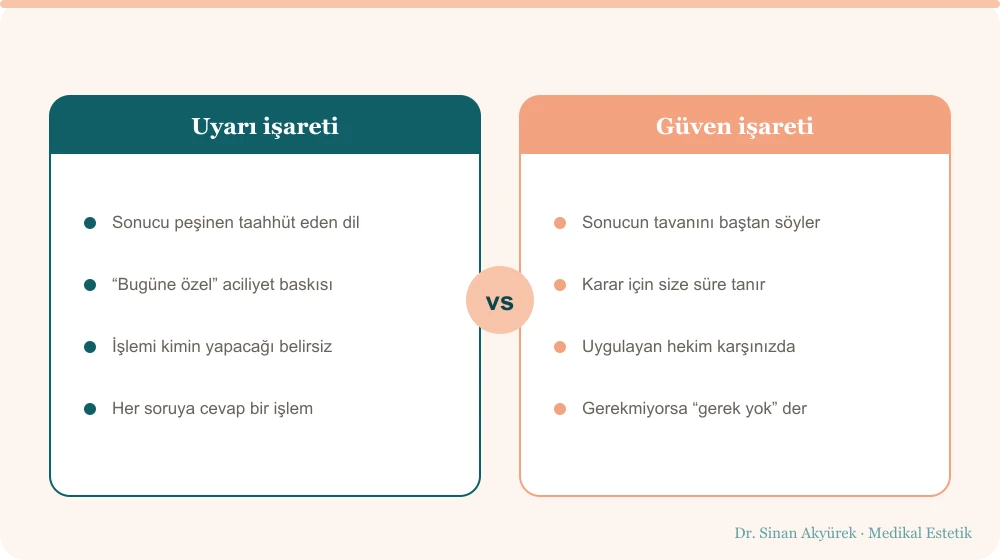
Here is the picture I see in practice. The patient meets the doctor, the doctor makes the plan, and someone else entirely does the treatment. The way to find out is very simple: ask. The question “Who will be doing this procedure today?” offends nobody. If it does offend, you already have your answer. If the reply is clear, a name is given and that person comes out and looks at your face, you are halfway there.
There is also the matter of how long someone has been doing this work. Aesthetic medicine is a field built on repetition. The difference between a hand that has done the same procedure hundreds of times and a hand doing it for the first time shows at the moment of a complication. Nobody should be bothered when you ask, “How many have you done?“
2. What does a wall of certificates tell you, and what doesn’t it?
You’ll see framed certificates on the wall. They have value, but they don’t prove what you think they prove. A certificate shows that someone attended a course or completed a training. It doesn’t show that they will do that procedure well on your face. There are people who get a filler or botox certificate in three months and start treating patients.
So I look less at whether there is a certificate and more at who issued it. A university, a national specialty association or the official training of the product’s manufacturer means something. A certificate from a two-day programme with no clear organiser doesn’t mean much.
What really matters is specialisation and continuity. The field the doctor works in, whether they attend current congresses and whether they are a member of a professional association are more meaningful signs than the number of frames on the wall. Don’t hesitate to ask about these. A serious doctor takes the question as interest.
3. Can they say “no” to you?
This is the criterion I value most. What shows a clinic’s quality fastest is the procedure it doesn’t sell you.
Several times a week at consultations I say, “You don’t need to have this done.” Sometimes the procedure the patient wants won’t change anything on their face. Sometimes the problem is in another layer, and sometimes the expectation isn’t realistic. Take botox for sweaty palms, for example. It is a treatment that can be done, but I don’t do it for most people. However careful you are, it limits hand movement to some degree, so I rarely recommend it to musicians or to people who work at a computer all day. When I’m asked about something outside my field, I say so openly: I’m not a surgeon, so I don’t do surgical work, and I refer my patient to a colleague who does.
Pay attention to the language of the promise, too. Sentences that commit to a result in advance, or imply that the result won’t vary from person to person, are not sentences medicine can stand behind. The most we can tell you is this: in patients in a similar situation we usually see improvement within a certain range, it varies from person to person and it needs refreshing. An honest doctor tells you the ceiling of the result from the start.
Pressure is a warning sign as well. Urgency lines like “today only” or “if you decide now” belong to sales. The situation in which you have to hurry a health decision is an urgent health problem. An aesthetic plan doesn’t fall into that category.
4. How do you judge what you can’t see: hygiene and sterilisation
Sterilisation is the area the patient can see least and is affected by most. You can’t look inside the autoclave, and you can’t follow the cold chain of the product. Even so, the indirect signs tell you quite a lot.
There are a few things you can look at. Is the treatment room separate from the waiting area? Is the treatment couch prepared with a single-use cover that is changed between patients? Does the doctor put on gloves in front of you? Are you shown the box and the expiry date of the product, and are the needles opened from their packaging beside you? None of this needs special knowledge. It only needs attention.
The source of the product is a separate matter. Medical products used in Türkiye have to be licensed and traceable. A filler that comes with Ministry of Health approval should have a CE certificate. You can scan the barcode on the box and check it in the Product Tracking System (ÜTS). Asking the name of the product that will be used and seeing its box is your most natural right. When you hear of an unusually cheap treatment, the first question that should come to mind is “why is it so cheap?”, because in this work a low price usually comes out of the material.
5. Are they looking at your face, or at a list?
The last criterion is a little more abstract, but it makes the biggest difference. In a good assessment, the doctor listens to you first and then reads your face as a whole. In a poor one, the doctor holds a menu and tries to fit you into it.
Think of the face layer by layer. At the bottom there is bone, above it a fat layer, muscles in between, then a superficial fat layer, the connective tissue that ties all of these together, and the skin on top. Your complaint may be “I look tired”, but its source could be any one of these layers. That is why, in a serious consultation, where the problem lies is discussed before which procedure will be done.
There is also a side of this that sits outside the layers. Sleep, nutrition, sun, smoking and hormonal status are directly linked to how the skin and tissue look. I often tell my patients: we help your tissue recover; protecting it is your homework. A good plan includes that conversation too.
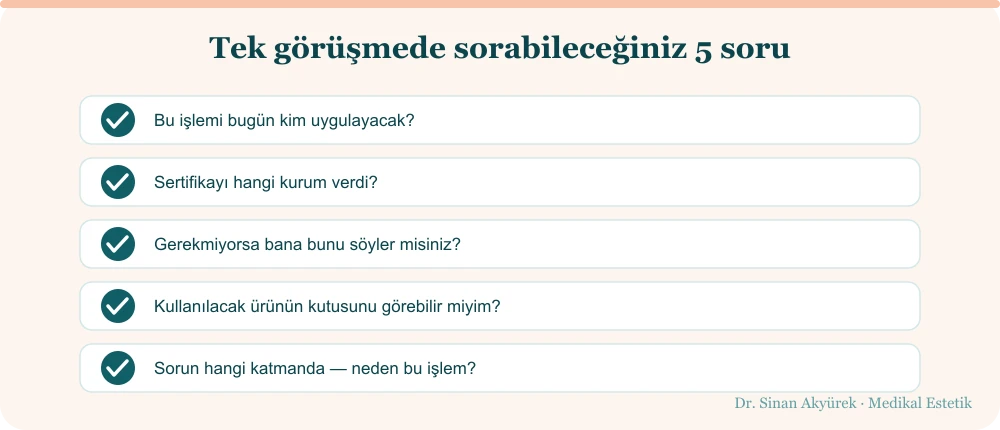
To be honest, these five criteria won’t give you a flawless result. Medicine offers no such assurance. They will, however, seriously lower your chances of making a bad choice. Don’t have a procedure done in a place where you don’t feel comfortable and can’t ask questions. You can ask about all five of these at your first consultation, and how clear the answers are will tell you enough about that clinic.
Sources & Further Reading
- Turkish Ministry of Health / TITCK — regulations on medical devices, licensed products and healthcare facilities: titck.gov.tr
- American Academy of Dermatology — patient guidance on choosing a physician before a cosmetic procedure: aad.org
- Cleveland Clinic — cosmetic procedures, risks and patient safety: my.clevelandclinic.org
- ISAPS — international standards of aesthetic practice and patient safety principles: isaps.org