What Actually Happens in a First Consultation? From the Door to the Plan
Dr. Sinan Akyürek on the first medical aesthetics consultation: how a face is analysed, how expectations are discussed, how a plan is built and what to ask.

“I haven’t really decided what I want to have done. Is it all right if I just come in?” We hear this question on the phone very often. It is. In fact, I prefer it. Talking to a patient who has already made up their mind online and picked the name of the procedure is harder for me. By that point we have already skipped the real question, which is what is bothering you. At the first consultation we start by naming the problem together. Choosing a procedure comes later.
In this article I’ll go through what happens at that appointment, in order. My aim is for you to know what to expect when you walk through the door. The unknown makes people tense, and a tense person can’t ask the right questions. In that half hour, the questions you ask matter as much as the examination I carry out.
A consultation is an examination
In medical aesthetics, a consultation is a medical assessment. The complaint is heard, a medical history is taken, an examination is done, and then a plan comes out of it. There is an order to this, and the plan comes at the end.
It isn’t hard to tell whether a conversation is an examination, either. In an examination you are asked questions. When did it start, does anyone in your family have something similar, what do you use regularly, what have you had done before? In a promotional meeting, a list is put in front of you and you are expected to choose from it. You can tell the difference by what you are holding when you leave. Did you walk out with a list of procedures, or with an assessment that explains how your face was read?
A consultation goes both ways. While I am assessing you, you are assessing me. This is perfectly natural, and I encourage it. Good decisions aren’t made at a table where you feel uneasy or hesitate to ask questions. Reading about how I work beforehand is part of that assessment too.
How does the appointment go, step by step?
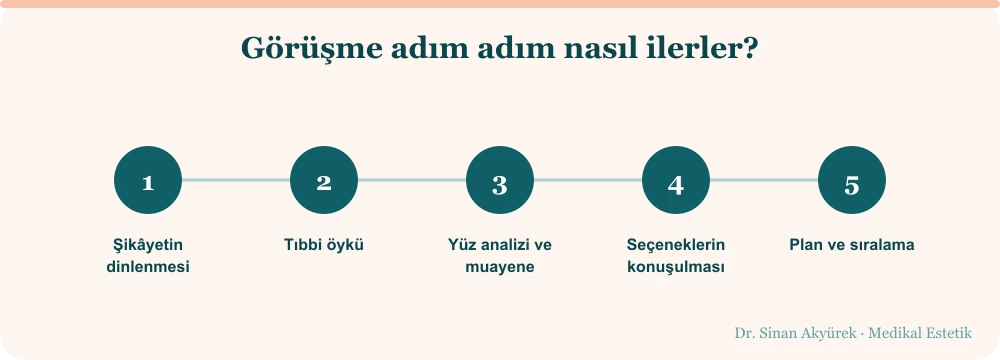
Whatever procedure is being discussed, the appointment follows almost the same order every time.
First, I listen to your complaint. What is really bothering you? “I look tired” and “the lines beside my nose” are two very different sentences, and they lead to two very different plans.
Then we take your medical history. Chronic illnesses, treatments and supplements you use regularly, allergies, pregnancy or breastfeeding, procedures you have had before. This part can feel tedious, but it is where all of the safety lies.
The third step is facial analysis and examination. I assess the face as a whole, both at rest and in motion. I look at symmetry, proportions, how the volume is distributed and the quality of the skin.
Next we talk about the options. Which approaches are possible, what each one does and what it doesn’t do. If you are offered only one option, this part has been left incomplete.
Last come the plan and the order of treatment. What will be done first and what later, how many sessions it will take, how far apart the sessions will be and when the result will settle.
All of these steps fit into one appointment. If they don’t, there is no hurry. We schedule a second appointment so that you don’t have to decide on half the information.
Which layer is the reflection in the mirror coming from?
This is the most important part of the appointment. The complaint a patient describes and the source of that complaint are often not in the same place.
The face is built in layers. Bone is at the bottom, and above it there are fat pads, muscle and connective tissue, with skin on top. In a patient who says “I look tired,” the problem may be in the skin. It may be the loss of fat support in the cheekbone area. It may also be a chin that sits back. So in the examination, the first thing I ask myself is where this appearance is coming from. What we should do comes after that. A treatment done without reading the layer correctly doesn’t fix the picture.
There are cases where a whole-face approach such as the liquid facelift is right, and cases where filler in a single area is right. This reading decides which one suits you.
Facial analysis doesn’t require a special device. An experienced eye, good light, and watching the patient as they talk, smile and raise their eyebrows usually give the most valuable information.
Sometimes the right answer is “you don’t need it”
Not every appointment ends with a decision to treat. Nor does it have to.
In some patients the source of the complaint has nothing to do with aesthetics. It may be sleep habits, iron deficiency, too much sun or smoking. In others, the procedure they are asking for won’t really change anything in the face. In some, the expectation is higher than what medicine can offer. In all of these cases, even if it is commercially difficult, the right sentence is “you don’t need to have this done.”
Unfortunately, there are complaints I can’t make disappear completely. If there is marked sagging, I can’t give a surgical result with a needle. At the start of the appointment I tell you how much we can soften and where the ceiling is.
I’ll add one more thing. We help improve your tissue. Keeping the result we achieve is your homework. Sunscreen, regular sleep and staying away from cigarettes keep working for longer than any procedure I do.
Ask these before you leave
It works better for everyone when the patient also comes to the appointment well prepared. Keep a few questions in mind. Each of them has a short, clear answer.
The first question is what exactly is causing your complaint. In the answer you should hear a layer or a mechanism. If all you hear is the name of a product, ask one more question.
The second is how many sessions the plan will take and over what period. If the timeline is vague, the plan is vague too.
The third is how long the effect will last and what happens afterwards. Be cautious about anything described as permanent.
The fourth is what happens if you don’t have it done. Will waiting cost you anything? Most aesthetic decisions are not urgent. A sense of urgency rarely comes from a medical reason.
The fifth is which side effects are normal and in which situation you should call your doctor. Don’t have a procedure done without a number you can reach.
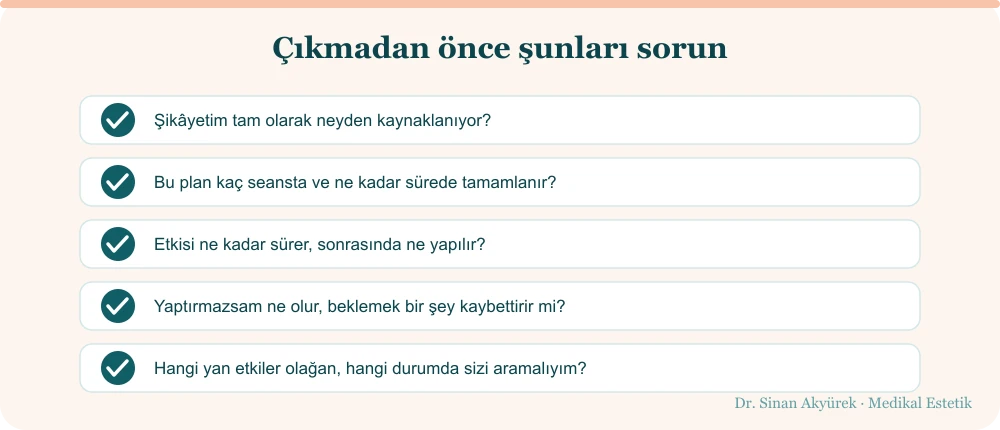
Once you have the answers to these questions, you are able to make the decision yourself.
Sources & Further Reading
- Turkish Ministry of Health / TİTCK — regulations on health service provision, licensed products and promotion: titck.gov.tr
- American Academy of Dermatology — patient guidance and expectation setting before cosmetic procedures: aad.org
- Cleveland Clinic — informed consent and patient safety in cosmetic procedures: my.clevelandclinic.org
- Mayo Clinic — general guidance on preparing for an appointment and questions to ask your doctor: mayoclinic.org