The Male Jawline: How a Masculine Proportion Is Built
Dr. Sinan Akyürek on jawline filler in men — the proportion behind a masculine jaw, what filler really does, and why facial analysis comes first.

These days, what my male patients most often show me on their phones at the consultation is the sharp jaw profile of an actor or a footballer. “Doctor, I want a line like this,” they say. Then they usually add, “but I don’t want it to show, I don’t want to look overdone.” I pay more attention to that second sentence, because that is where the real skill lies. So is a sharp jawline about the amount of filler?
To be honest, not really. A masculine jawline is first of all a matter of proportion. The skeleton of a female face and a male face, and with it the soft tissue on top, sit at different angles. In women, for example, the cheekbones face a little more forward, while in men they sit wider. In the lower face, a man has a wider jaw, a more defined jaw angle and a chin that ends clearly forward. If you don’t work with the anatomy, you can make a man’s face look feminine without realising it. So at the consultation the first thing I think about is the angle. The amount comes later. Even a very small amount of filler in the wrong place can make the face look feminine or puffy. The same amount placed at the right corner can make the face look clearly more masculine.
Which lines make up a masculine jawline?
When people say “jawline,” they picture a single line, the one running from below the ear down to the chin. What we look at is a frame. This frame has three stops.
The first is the jaw angle, the mandibular angle. It is the corner just below the earlobe. In men this corner needs to be defined, slightly flared outward and almost upright. This is the point that really carries the masculine expression. The second is the body line that connects this corner to the chin tip. It should be a smooth, straight line that casts a shadow. The third is the chin tip itself. In men, a chin that is a little wider and more forward balances the face. When one of these is missing, the frame isn’t complete.
When I do jawline filler in men, my aim is to complete this frame. In some patients we only define the corner. In others we correct the shadow line between the chin tip and the corner. It is rare to need all three.
How does filler define this line?
We work under the skin, right on top of the bone. The hyaluronic acid filler we use does different jobs depending on its consistency. Supporting a hollowed area of the face with filler is a bit like stretching a tent canvas from below with a pole. The firm, resistant product we place at the jaw angle and on the bone sits there as that kind of structural support. It pushes the tissue outward and sharpens the shadow.
Why on the bone? Because what carries a masculine look is the clean edge underneath. A soft filler close to the surface puffs the face up without sharpening it. Filler placed deep, resting against the bone, breaks up the light and creates shadow. What the eye reads as a “sharp jaw” is that shadow.

I want to be honest about one point. Filler doesn’t change bone. In a patient whose lower jaw is very weak and underdeveloped, there is a ceiling to what filler alone can do. In that situation I tell my patient so, plainly. It isn’t my job to make the goal look bigger than it really is.
How do you do it without overdoing it?
The most common mistake I see in male aesthetics is putting more product than needed into the jaw angle. The lower face ends up disproportionately wide, and a patient who should look strong looks swollen. Something similar happens at the chin tip. If you put filler only on the tip of the chin, like a small knob, it looks like a separate piece sitting apart from the surrounding tissue. When you also support the tip from the sides and keep the proportion, it looks far more natural.
I prefer to work in stages. In the first session we lay the foundation with a measured amount and wait for the tissue to settle. If needed, we add a fine touch a few weeks later. You can always place a little and add more. Placing too much and then taking it back wears the patient out. If the patient isn’t happy with it, hyaluronic acid filler can be dissolved with a special enzyme. Knowing it can be reversed reassures my male patients, especially those having filler for the first time.
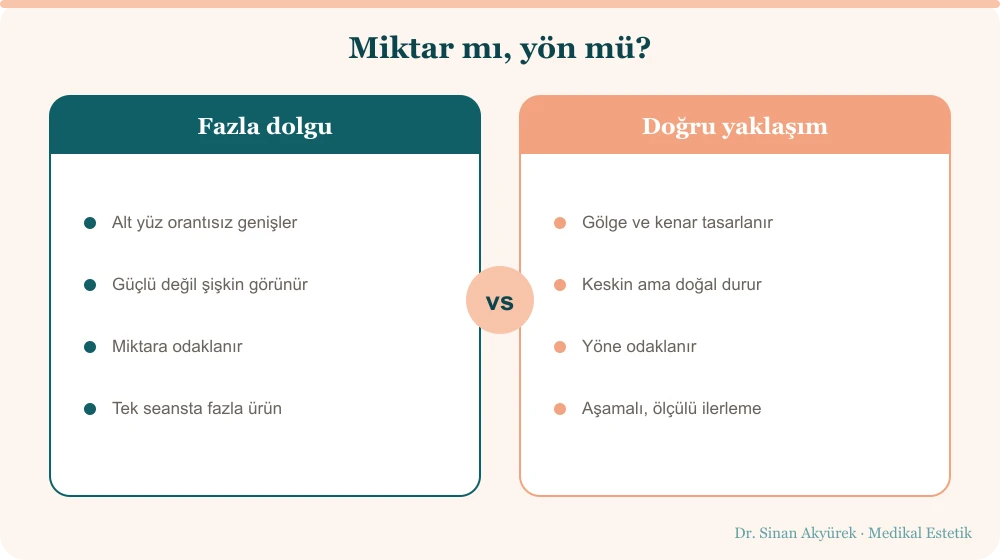
We also need to look at the face as a whole. A sharp jawline often falls flat next to a receding chin or a poorly defined neck-to-jaw angle. For some of my patients, the right first step is bringing the profile forward with chin filler. In patients whose jaw muscle has thickened from teeth clenching and squared off the face, masseter botox sometimes completes the picture. We thin the muscle a little, and the line comes through.
Why is facial analysis the first step?
These decisions can’t be judged by eye. That’s why I don’t plan filler for any male patient without an analysis. I look at the symmetry of the face, the angle of the jaw corner, where the chin tip sits in profile and the transition from neck to jaw. I also look at how this line moves when the patient smiles and talks. Most people skip this.
A line that looks good in a still photo can look strange once the face moves. So I build the plan only after I have seen the face both at rest and in motion.
I also want to be clear about expectations. Jawline filler is not a permanent procedure. Depending on the product used and the person’s metabolism, its effect fades over time and needs a top-up. I see this as an advantage as well. As the face ages, its needs change, and we update the plan to match.
Sources & Further Reading
- Turkish Ministry of Health / TİTCK — regulations on medical device and injectable product safety: titck.gov.tr
- American Academy of Dermatology — patient information on soft-tissue fillers: aad.org
- Cleveland Clinic — general information and safety on dermal fillers: my.clevelandclinic.org
- PubMed — clinical literature on hyaluronic acid fillers in facial aesthetics: pubmed.ncbi.nlm.nih.gov