Filler or Biological Renewal? MCT Exo-Tech, Explained in Plain Language
What is MCT Exo-Tech and how does it differ from classic filler? Dr. Sinan Akyürek explains the approach that triggers the skin's own renewal.

“Doctor, I don’t want filler, but my skin looks tired and I want something done.” In recent years I hear this sentence very often in consultations. Most of these patients have seen overdone filler before and become wary, yet they find themselves dull in the mirror. What they want is for their skin to come back to life. With a patient like this, I start by explaining regenerative approaches such as MCT Exo-Tech. First I have to correct a misunderstanding. Many people think it is a stronger kind of filler. The logic is completely different.
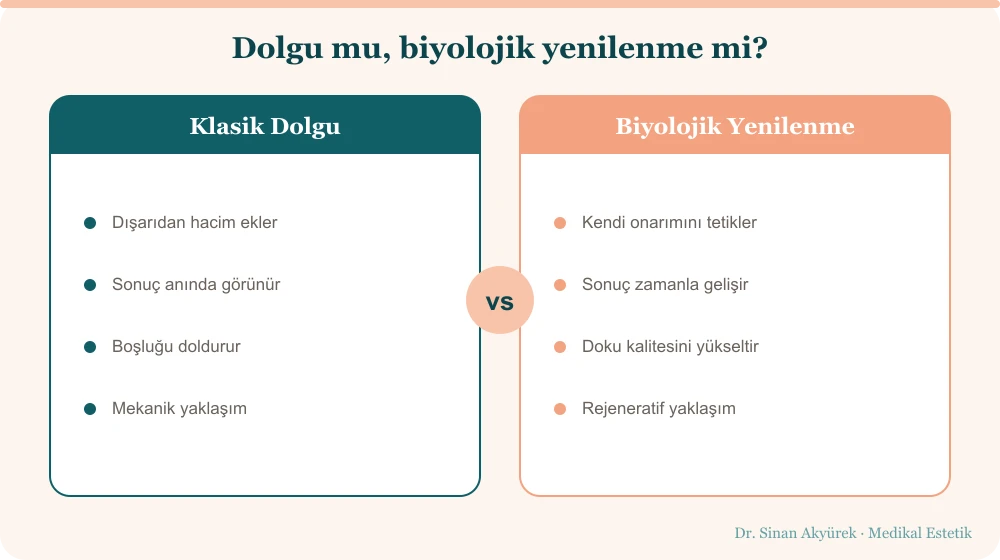
Are filler and biological renewal the same thing?
The logic of classic filler is simple. If there is volume loss somewhere, you place a substance there from the outside, usually hyaluronic acid, and fill that gap. It is a bit like slipping a wedge under a sagging structure. The result is visible at once, and it is mechanical. Planned correctly, filler is a very valuable tool, and I use it often myself.
Biological renewal works the other way round. Here we encourage the skin’s own cells to start working again. Our aim is to raise the tissue’s own quality from within. MCT Exo-Tech belongs to this second group. A patient who grasps this distinction understands much more clearly why I sometimes recommend filler and sometimes a regenerative treatment.
What exactly does MCT Exo-Tech do?
MCT Exo-Tech is a tissue-repair approach that brings together exosome and bio-implant technology. The name is technical, but the logic is intuitive. Exosomes are tiny packages of information that cells use when they send messages to one another. They carry growth factors and cellular signals. When these signals reach the skin, our aim is for the collagen-producing cells we call fibroblasts to get moving again.
I compare fibroblasts to bricklayers. As we age, these bricklayers keep working with the technique they used forty years ago. With exosomes we teach them the new techniques and hand them good-quality cement and good-quality bricks. So we are not putting ready-made collagen in from outside; we are stimulating the skin’s own collagen and elastin production. The bio-implant side gives the tissue a scaffold, a base to work on, and helps the repair progress in a more orderly way.
Who does it make sense for?
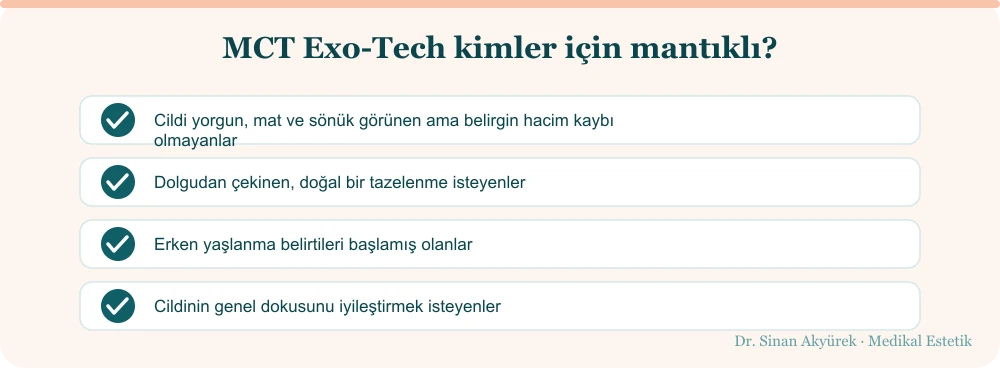
Not every treatment suits everyone. Sometimes I even tell a patient, “this is not what you need.” But there is a profile that MCT Exo-Tech fits well.
First among them are patients whose skin looks tired, dull and lacklustre but who have no marked volume loss. In these patients the problem lies in the quality of the skin. People who are wary of filler and want to feel “I look rested” instead of “I’ve changed” belong to this group too. So do those who have started to see early signs of ageing and want to slow down fine lines and the loss of elasticity. It also makes sense for a patient who has had various procedures before and now wants to improve the overall texture of the skin.
The situation changes if there is real, marked volume loss, for example if the support under the cheekbones has decreased significantly. Regenerative treatment alone does not fill that gap; a balanced filler plan is more appropriate there. So first the problem has to be named. Is it collagen loss, volume loss, or a problem with the surface of the skin? I make the decision by looking at the face as a whole.
How many sessions, and when do results come?
This is the topic people are most curious about, and the one where the most mistaken expectations arise. In regenerative treatment the result appears over time, because you are waiting for the skin’s own production. I usually plan a protocol of a few sessions and leave time between them for the skin to work. The exact number depends on the condition of the skin, age and expectations.
In the first weeks most patients notice an increase in glow and hydration. The real change, the improvement in tissue quality, matures over a few months. In regenerative medicine, patience is part of the treatment. I tell my patients this from the start, because someone who comes in expecting to wake up looking different tomorrow may be disappointed by this slow process.
Realistic expectations: what it does, and what it does not
Honest expectations are at the centre of the way I work. MCT Exo-Tech supports skin quality, encourages the tissue to repair itself, and gives a feeling of freshness and hydration. But it does not stop gravity. On its own it does not lift significant sagging, and it does not fully reverse ageing either.
We get the best result in the right patient, with the right plan. Sometimes I consider this approach together with stem cell and other regenerative methods. Sometimes the answer is MCT Exo-Tech, sometimes a simpler maintenance protocol. Which one it is becomes clear in the examination, once I see your skin.