Medical Glass Skin: The Clinic Version of the Korean Facial
Dr. Sinan Akyürek explains why the Korean glass-skin facial fades in days, what the medical glass skin protocol does in one session and who it suits.

For the last few months I have been hearing a new sentence at consultations: “Doctor, there’s that Korean glass skin thing, I want to have it done.” You watch these videos on social media, and so do we. I came across them too. People go to Korea, walk out of a facial, and their skin shines like glass. The photos really are beautiful.
So where does that shine come from, and why can the same person not take the same photo two weeks later? I’ll explain that first. Then it will be easier to talk about where the protocol we call medical glass skin parts ways with it.
What does the Korean glass skin facial actually do?
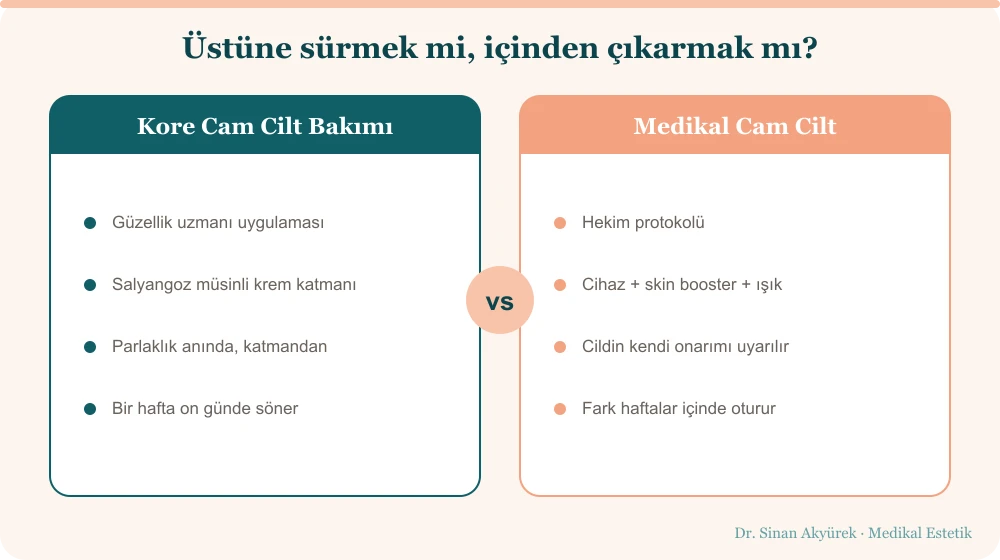
I looked into it, and the Korean version is not a procedure done by a doctor. A beautician cleanses the skin, gives it a facial and, at the very end, applies a moisturising, repairing cream. The ingredient in that cream is mucin, the substance secreted by snails. Once it is on, a transparent, glossy layer forms on top of the skin and light reflects evenly off that layer. The photo is taken at exactly that moment.
So the shine you see belongs to the layer on top of the skin, the cream’s layer. It carries you for a few days, a week or ten days at most, and then it starts to fade. Is that a bad thing? No, as a facial it is lovely. It doesn’t repair anything in the skin itself, though.
I should also give credit where it’s due. Koreans really care about their skin. Korean friends I have met through my work go to great lengths to stay out of the sun, to protect that fair complexion from sun damage. That culture is behind the glass skin idea. It’s a good idea. So I asked myself: how can we adapt this for ourselves?
Where does medical glass skin part ways?
The difference actually fits in one sentence. The Korean version puts the shine on top of the skin; we try to bring that shine out from inside the skin. To do that, I made a few small changes to the system, and our clinic’s own protocol came out of it. This is the protocol we will be using this year.
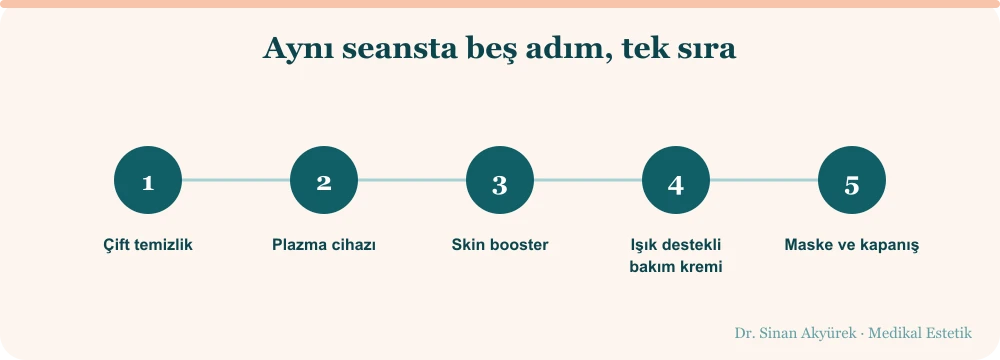
Here is the logic. First we wake up the skin’s own repair mechanisms, then we feed the cells we have woken, and finally we calm the skin down. The devices do the waking, the skin booster does the feeding, and the mask and closing care do the calming. We set this order on purpose; each step opens the way for the next.
So what exactly happens along the way? I’ll go through it step by step.
What do we do in one session, and in what order?
- Double cleanse. We use an oil-based cleanser first, then a water-based one. People underestimate this step, but whatever you give to skin that still carries make-up residue and sebum, half of it gets lost on the way.
- Plasma device. We gently loosen the cells in the outermost layer of the skin. This opens the pores, and the solutions we apply afterwards work into the skin more easily. Because plasma turns the oxygen around it into ozone, it also balances the skin flora, which is an extra help in my patients with active acne. At the same time, we nudge the production of collagen and elastin, the structures that carry the skin’s firmness. In our language this is a wake-up call: “You’ve been lying around for years, time to get to work.” No needle is used at this stage and there is no pain.
- Skin booster. We deliver a product containing both exosomes and PDRN into the skin by micro-injection. This is where we feed the cells we woke with the device. It is the step that supports the gradual repair of things like uneven tone and fine lines.
- Light-assisted care cream. After applying the repairing cream, we use a device that emits red and near-infrared light to work it deeper into the skin. Again there is no needle and no numbing is needed. The device glides over the skin, and while the light nudges collagen and elastin production, it also helps the cream pass into the skin.
- Mask and closing care. We give hydration and nourishment with an exosome-supported mask. Then we finish with closing care that calms the skin and settles any redness.
When the session is over, you go back to your daily life. Then I call you in for a check-up, because I want to see the change myself too.
Who is it for, and who is it not for?
Who do I refer to this protocol most often at consultation? My patients with dry skin. Dryness rarely comes as a single complaint. Fine lines linked to dryness, blemishes, uneven tone and that dull, lightless look often come from the same source. When you feed the source, these complaints respond together. So the group that benefits most from medical glass skin is our patients with dry skin.
Now I’ll draw the line. For a patient whose main problem is volume loss or sagging, this protocol alone won’t meet the expectation. That patient’s plan is built differently, and if needed this protocol becomes one part of it. It doesn’t close deep acne scars and it doesn’t replace fractional laser. It doesn’t count as a pigmentation treatment either. It supports the appearance of uneven tone, but it can’t do the work of treatments that target pigment.
Then there is the question of season. The plasma stage doesn’t create sun sensitivity the way a laser does, so we can apply this protocol in the summer months too. If a patient has sunburnt skin, we postpone it. Protecting your skin from the sun after the treatment is your homework, and there is no bargaining on that. Pregnancy and breastfeeding, devices such as a pacemaker and any known sensitivity to the ingredients are discussed separately at the consultation.
Can it sit in the same plan as Detox Lift?
I’m asked this often, because there are patients for whom I plan both. Yes, it can, but the two do different jobs. Detox Lift works on muscle tone and lymphatic drainage, so it deals with the deeper layer of the face. Medical glass skin deals with the quality of the surface, with the skin itself.
Which patients get both and which get only one becomes clear at the consultation. Same day or separate days, and in what order? I plan all of that; my patient simply comes in.
When does the result show?
After the session my patients describe a feeling of freshness and hydration. That first day is the day the skin feels good. The real difference appears over the following weeks, because what we are waiting for is the skin’s own production. When you wake the cells up and feed them, they work, but they work at their own pace.
How long does it last? That depends on your home care, how well you protect yourself from the sun and the condition your skin started in. That is why I make no promises about permanence. The number of sessions you need also varies from person to person; we decide together at the check-up after the first session.
Sources & Further Reading
- American Academy of Dermatology — Dry skin: Diagnosis and treatment
- Cleveland Clinic — Skin barrier
- PubMed — Polydeoxyribonucleotide (PDRN) in skin regeneration, literature
- Turkish Medicines and Medical Devices Agency (TİTCK) — Cosmetics and medical device regulation