Regenerative Medicine and Stem Cells: What Do They Actually Mean in Aesthetics?
What does regenerative medicine really do in aesthetics — and what does it never promise? Dr. Sinan Akyürek draws an honest, unexaggerated line.

“Stem cell” is just two words. But the moment I use them in a consultation, the expectation in the patient’s eyes often goes far beyond reality. For some it is a cure for everything, for some an expensive fad, for others science fiction. Regenerative medicine is none of these. It is a real field with real limits, and it needs to be talked about carefully. I have explained this topic on national television as well, because misinformation does particular harm here. Let me tell you, through a physician’s eyes, what it really does in aesthetics and what it does not do.
What is regenerative medicine, and where do stem cells fit in?
Now, in its simplest form, regenerative medicine is an approach that aims to wake up the body’s own capacity for repair. In classical treatment we often suppress a problem with a substance from outside. Here we are trying to give the tissue a “repair yourself” signal. Stem cells are the most talked-about part of this framework, and also the most exaggerated.
Stem cells are cells that have not yet decided what they will become, with the capacity to build tissue from scratch. Adults have them too, in two kinds. Some sit inside a tissue and can repair only that tissue. Others sit in the bone marrow or among the fat cells and can repair more than one tissue; these are what we call mesenchymal stem cells. If all you have in mind is a repair of the skin, cells obtained from small pieces of skin taken from behind the ear will do the job. If you also want to repair deeper tissues such as fat, bone, connective tissue and muscle, you need mesenchymal stem cells.
There is one more distinction you should know. Some of the treatments you hear called “stem cell treatment” in aesthetics draw more on the signalling molecules the cell produces, growth factors and exosomes, than on the cell itself. The micro-graft treatment we do for hair is also popularly known as stem cell treatment. So not everything you hear about is a direct transplant of stem cells. Most exaggerated promises feed on this blur.
Why do I look at it this way?
I came to medicine through classical medicine; I studied at Cerrahpaşa, and later I also began working with complementary medicine practices. The two sit side by side in me. Classical medicine taught me evidence and doubt. If there is a claim, I ask what it rests on. One of my followers once wrote that “one session of stem cells equals ten sessions of ozone.” There is no such study, and I asked for the source. The second perspective taught me not to see the face as a single area and to assess the person as a whole.
Regenerative medicine stands where these two meet. Used correctly, it is a powerful tool that mobilises the tissue’s own resources. The moment someone says “it solves everything,” though, it is marketing doing the talking. My job is to show the patient the line between the two honestly.
What does it really do in aesthetics?
Where it makes the most sense is tissue quality. By stimulating fibroblasts we support collagen and elastin production, and the skin looks more hydrated and firmer. We expect a gradual improvement in fine lines, tissue fatigue and a dull appearance. In scars, it can also help the tissue repair more cleanly. Sometimes it forms the base layer that completes procedures such as exosome treatments or MCT Exo-Tech.
Who it works best in also matters. I don’t think someone very young, without a serious wound or scar, really needs it. Above sixty, on the other hand, the person’s own stem cells have aged too, so the expected result may not come. The most suitable range, to my mind, is roughly 35 to 55. The result also takes patience: the cells need at least four weeks to work, and sometimes you have to wait two or three months.

What does it not do?
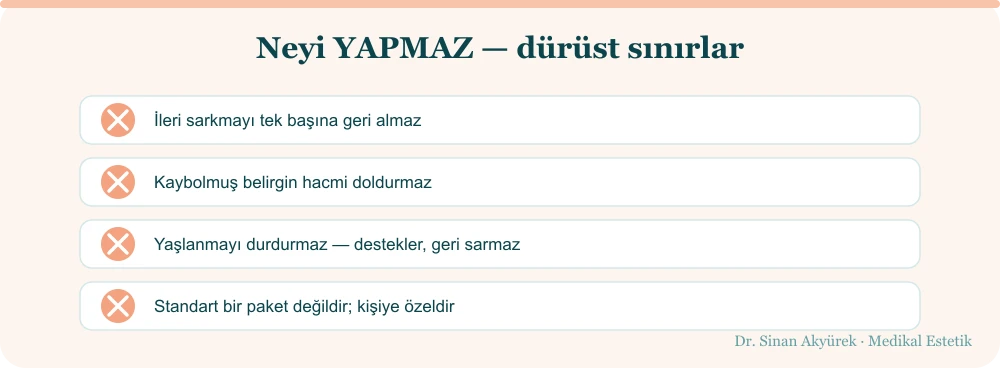
Actually, because stem cells also repair connective tissue, they do give the face some firming, and you see it more clearly after two or three months. But if there is advanced sagging, the conversation turns to surgery or thread-lift methods; stem cells alone will not do that job. With marked volume loss, a balanced filler plan is the more appropriate choice. It does not stop ageing either. It supports the process and can slow it down, but it does not turn back the clock. Nor is there a standard package applied the same way to everyone; the plan, the number of sessions and the realistic expectation vary from person to person.
Most people who come to the clinic have one idea in mind: “let me have a single procedure that helps with everything.” When a patient arrives saying “I’ll look ten years younger in a single session,” my first job is to bring that expectation gently back to reality.
Safety and regulation
Regenerative treatments are medical procedures and must be taken seriously. In Türkiye, stem cell and advanced regenerative treatments are regulated by law; which treatment can be done where, and under what conditions, is defined. Most of the “stem cells solve everything” content circulating online fits neither this framework nor scientific reality. When a treatment is suggested to you, the questions to ask are simple. What is its scientific basis? Is it within the legal framework? What does it promise me, and what does it not? An honest physician will gladly answer every one of these questions.
My approach is to use an exciting field within realistic and safe limits. I don’t reject it blindly, and I don’t exaggerate it either. Whether it makes sense for you is something we can only clarify in a face-to-face assessment.